
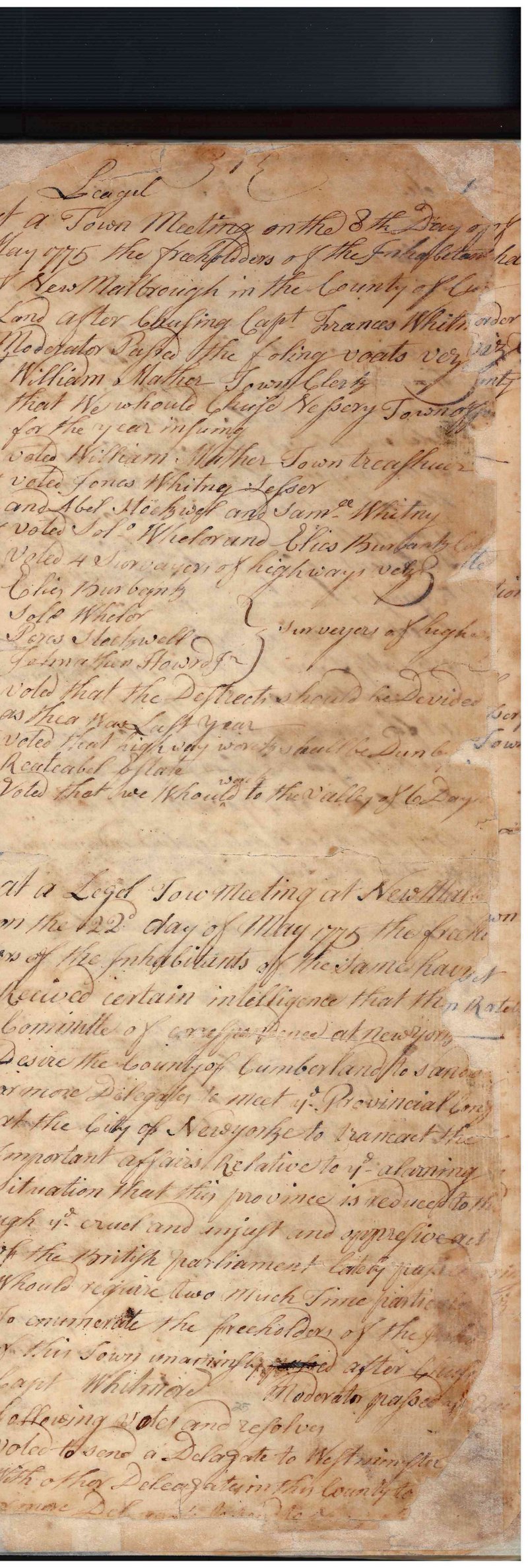
The certified copy arrived this week. The request went out on a Sunday; the copy came back within the week from a town clerk’s office open three days a week. That turnaround is worth noting.
The document is Marlboro, Vermont Town Records, Book 1, page 3, in the hand of town clerk William Mather: the record of New Marlborough’s first town meeting, May 8, 1775. One small note on the physical object: Elroy McKendree Newton’s History of the Town of Marlborough (1930) prints this text on pages 85-86 and cites it as “Vol. I, page 1.” The physical page is page 3 of Book 1. That discrepancy is probably a matter of how the volume’s opening leaves were numbered when Newton worked from it in the late 1920s. The content is the same.
Mather’s hand is clear throughout. He served as both town clerk (recording the votes) and town treasurer (named in vote 3), so his name appears twice: once as the recorder and once as the recorded.
The transcription#
Original spelling is preserved; square brackets are editorial; the clerk writes “Sol⁰ Whelor,” the period abbreviation of Solomon and a phonetic Wheeler, which Newton’s 1930 printed history renders “Solomon Wheeler.”
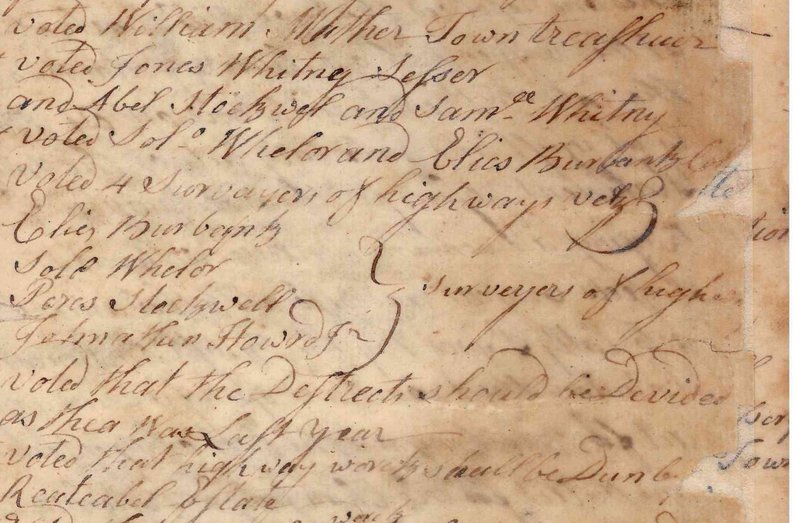
The first record, the May 8 town meeting:
at a Town Meeting on the 8th Day of
May 1775 the freeholders of the Inhabitant[s]
of New Marlbrough in the County of Cum[ber]
Land after Chusing Capt Frances Whitmor[e]
Moderator Pased the fol[low]ing voats viz
1st William Mather — Town Clerk
2d that We should Chuse Nesesry Town off[icers] for the year insuing
3d voted William Mather Town treashu[rer]
4th voted Jonas Whitney Sesser [Assessor] and Abel Stockwell and Sam[ue]ll Whitn[e]y
5th voted Sol⁰ Whelor and Elies Burbank Col[ectors]
6th voted 4 Surveyers of highways viz: Elies Burbank, Sol⁰ Whelor, Peres
Stockwell, Jonathan Howard J[unio]r — Surveyers of high[ways]
7th voted that the Destrects should be Devided as thay ware Last year
8th voted that highway work sh[o]ul[d] be Dun b[y] Reatable Estate
9th voted that we should [work] to the vallu of 6 Day[s] [a man]
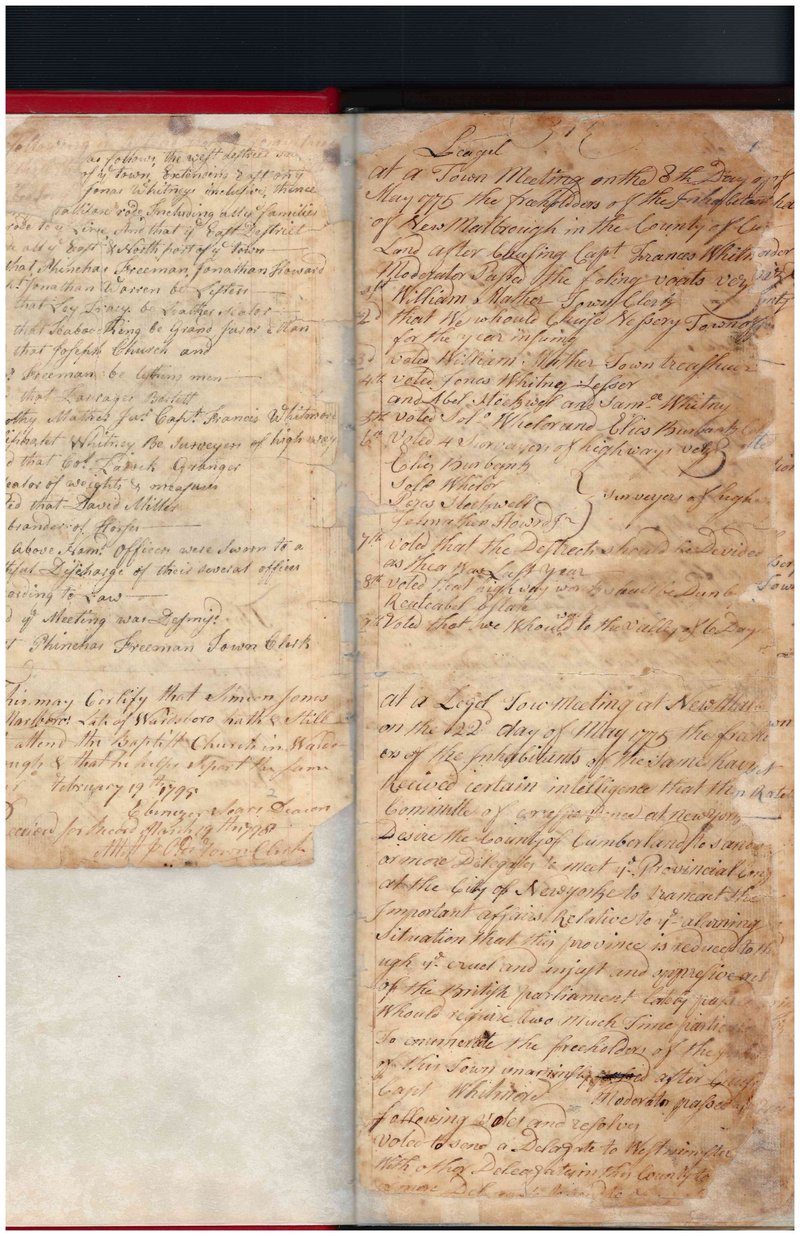
The second record begins at the foot of the same page, the May 22 meeting:
at a Legel Tow[n] Meeting at New Marlbu[rough]
on the 22d day of May 1775 the freehol[d]ers of the Inhabitants of the Same
have[ing] Received certain intelligence that the Committe of correspondance at
New York Desire the County of Cumberland to san[d one] or more Delegates to
meet y⁰ Provincial Con[gress] at the City of Newyorke to transact the
Important affairs Relative to y⁰ alarming Situation that this province is
reduced to th[ro]ugh y⁰ cruel and unjust and oppresive act[s] of the British
parliament Latly pased … Voted to send a Delegate to Westminster With
othe[r] Delegates in this County …
What these two entries mean#
Votes 5 and 6 put Solomon Wheeler in town office: Collector (the town’s tax officer) and one of four Surveyors of Highways, elected by the freeholders of New Marlborough, for “the year insuing.” The date was May 8, 1775, nineteen days after Lexington and Concord.
The May 22 meeting, which breaks off at the foot of this page and continues on page 4 (a follow-up request to the clerk is out), is the town choosing sides. As Newton prints the full text, the freeholders resolved that the King’s courts “ought to be suspended,” pledged resistance “at the expense of our lives and fortunes to the last extremity,” and voted to be “subject to the honorable Continental Congress.”
Under the SAR’s rules for civil service (elected town office under a government supporting the Revolution; tax collectors are named expressly in section 2.2002c of the Genealogy Policy Manual), this page is the primary evidence for Solomon Wheeler’s patriotic service. A supplemental application using this record is in preparation. It has not been approved.
The real record#
Three days after learning the sheriff’s warrant belonged to another man, the family’s real Revolutionary record turned out to be a farmer taking on the town’s least glamorous jobs in a settlement of fourteen families that, two weeks later, declared for the Continental Congress. The full story is in Nineteen Days After Lexington and The Two Solomon Wheelers.
Sources#
- Marlboro, Vermont Town Records, Book 1, p. 3. Certified copy, Marlboro Town Clerk, July 2026.
- Newton, History of the Town of Marlborough, Windham County, Vermont (1930), pp. 85-86.
- SAR Genealogy Policy Manual, sections 2.2000, 2.2002c.
Previous posts in this series:
- Finally A Wheeler — January 4, 2026
- The Deputy Sheriff Question — January 5, 2026
- The Warrant in Hand — July 18, 2026
- The Two Solomon Wheelers — July 19, 2026
- Nineteen Days After Lexington — July 20, 2026