When I wrote about Solomon Wheeler in January 2026 and followed up the next day, I was working from catalog descriptions. I had never seen the actual document.
That has changed.
The document#
The warrant arrived from the Morgan Library and Museum (catalog reference MA 552.10). It is a two-sided document. The front is the arrest warrant; the back is Solomon Wheeler’s own handwritten return — what he did when he executed it.
The front: warrant issued 22 April 1777#
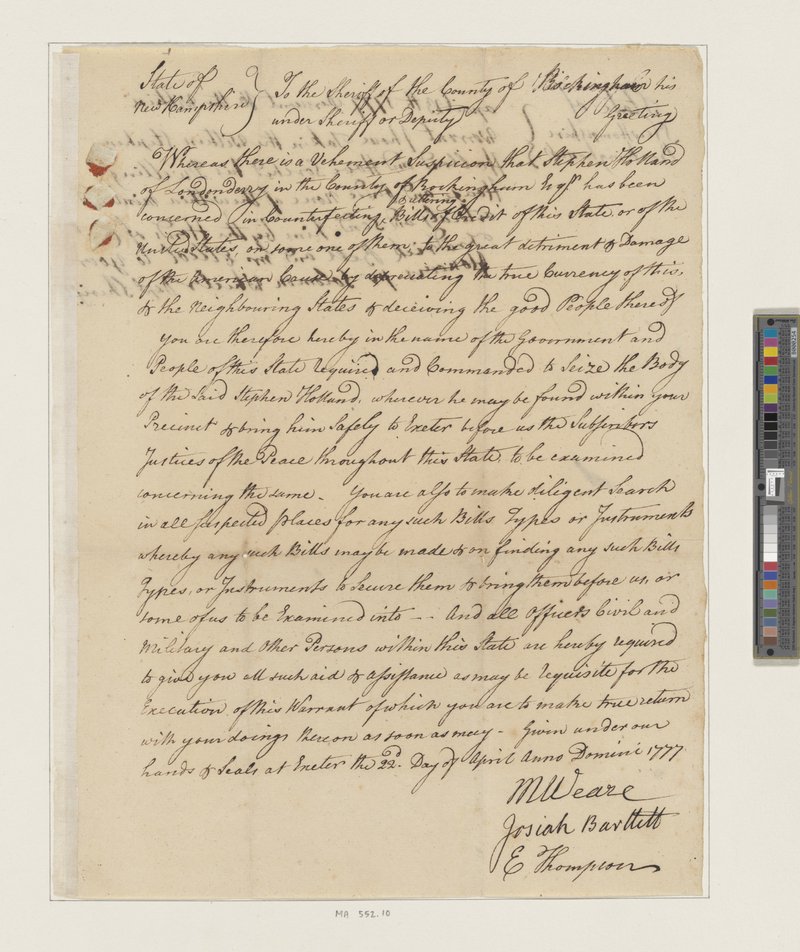
The text opens:
State of New Hampshire — To the Sheriff of the County of Rockingham his under Sheriff or Deputy — Greeting
It describes Stephen Holland of Londonderry, in the County of Rockingham, as under vehement suspicion of counterfeiting Bills of Credit of this State, or of the United States — crimes “to the great detriment & Damage of the American Cause, by depreciating the true Currency of this, & the Neighbouring States.”
The deputy is commanded to:
- Seize Holland’s body wherever found within his precinct
- Bring him safely to Exeter to be examined by the justices
- Search Holland’s dwelling for any bills, types, or instruments used in counterfeiting
- Secure and bring any such evidence before the justices
It closes:
Given under our hands & Seals at Exeter the 22. Day of April Anno Domini 1777
Signed by three men:
| Signer | Role |
|---|---|
| M Weare (Meshech Weare) | President of New Hampshire — the state’s wartime executive leader |
| Josiah Bartlett | Justice of the Peace throughout the State — and signer of the Declaration of Independence |
| E Thompson | Justice of the Peace (Ebenezer Thompson) |
That is not an ordinary trio. Bartlett had signed the Declaration less than a year earlier.
The back: Solomon Wheeler’s return, 23 April 1777#
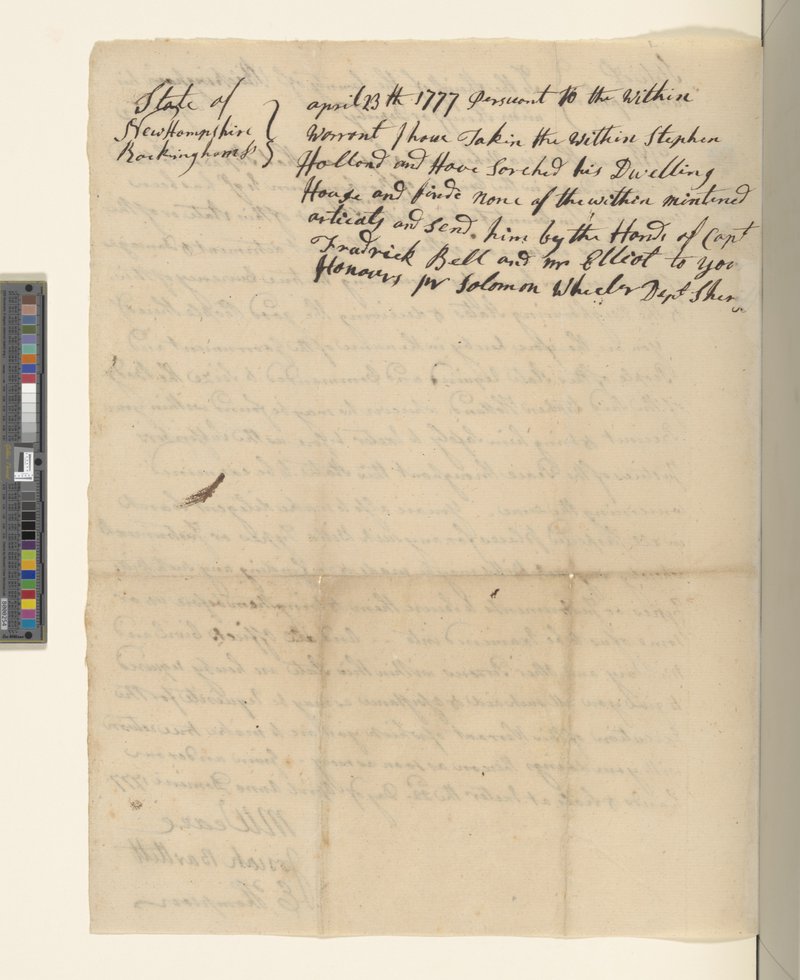
Written the very next day:
State of New Hampshire — Rockingham [County]
April 23th 1777 Pursuant to the Within Worrant I have Taken the Within Stephen Holland and Have Sorched his Dwelling House and finds none of the within mintened articles and send him by the Hands of Capt Fredrick Bell and Mr Elliot to you Honaurs pr Solomon Wheeler Dep. Sher.
In plain terms: Solomon arrested Holland the day after the warrant was issued, searched his house, found no counterfeiting materials, and forwarded the prisoner to Exeter by the hands of Captain Fredrick Bell and a Mr. Elliot.
He signed it Solomon Wheeler, Dep. Sher. — Deputy Sheriff.
What this means for the record#
This document does several things at once.
It puts Solomon Wheeler in Rockingham County in April 1777. He is not just named — he is writing in his own hand, executing a warrant, making an official return to the court.
It confirms the office. “Dep. Sher.” is unambiguous. He is a duly authorized deputy to the Sheriff of Rockingham County.
It connects him to the highest levels of New Hampshire’s wartime government. The warrant bearing his execution was issued by Meshech Weare and signed by Josiah Bartlett. This is not a routine constable’s errand — counterfeiting during the Revolution was a capital concern, treated as an act of economic warfare against the new nation.
It gives us his handwriting. That matters for future signature comparisons against other documents.
What I still need to prove#
I want to be precise: this document establishes that a Solomon Wheeler served as Deputy Sheriff of Rockingham County, New Hampshire, in April 1777. The next step — still underway — is demonstrating that this is my Solomon Wheeler: born 22 February 1747 in Shrewsbury, Worcester County, Massachusetts, married to Zipporah Harrington, later of Westmoreland, Cheshire County, New Hampshire.
The documentary chain I am building:
- Appointment or commission record naming the Deputy Sheriff (ideally with residence)
- Rockingham County records tying the deputy sheriff to known family members or associates
- Land, tax, or probate records placing my Solomon in southeastern New Hampshire before his Westmoreland years
- Signature comparison between this document and other signed Solomon Wheeler records
Why I’m including this in the supplemental application#
The SAR recognizes qualifying civil service during the Revolutionary period, not just militia service. A deputy sheriff executing warrants issued by the wartime State of New Hampshire — on orders from the President of the state and a signer of the Declaration — is exactly the kind of service the civil category was designed to capture.
This document is now part of my supplemental application file. It is primary-source, first-hand evidence: Solomon Wheeler’s own hand, his own signature, the day after the warrant was issued.
Previous posts in this series:
- Finally A Wheeler — January 4, 2026
- The Deputy Sheriff Question — January 5, 2026